
Why Does Concrete Fail in Raleigh, Durham, and Chapel Hill?
What causes sunken and cracked concrete?
Concrete is strong stuff. You can shape it into just about anything, and it’ll hold up for years. But it’s not indestructible. When you start seeing cracks, sinking, or flaking, it’s usually not the concrete itself that failed. It’s what’s going on underneath.
Around here, most concrete problems come down to the soil below the slab.
It Starts Underneath Your Concrete
Poorly Compacted Soil
When your home was built, the ground around it was dug up and then filled back in. Even when it’s compacted well, that replaced soil is never quite as stable as the original ground. Over time, it settles and shifts, which can leave empty spaces, also called voids, under your concrete. Once that support is gone, the slab above starts to sink or crack.
Dry Soil
Hot weather and dry spells can cause the soil under your concrete to shrink. As it pulls away, it creates gaps underneath the slab. Add some weight, like a car in the driveway, and the concrete can start to crack or drop into those spaces.
Heavy Rain & Flooding
Then the rain comes back. Water finds its way through cracks and joints and gets under the slab more easily. That moisture softens the soil, and in some cases can wash it out completely. Now you’ve got weak support, or no support at all, and that’s when you see bigger settling and uneven sections.
Poor Drainage
If water isn’t being directed away from your home, like downspouts dumping next to the slab or grading sloping the wrong way, it will keep working its way underneath your concrete. Over time, that constant moisture weakens the soil and leads to settling.
Heavy Loads
Concrete is strong, but it has limits. Parking heavy vehicles, like work trucks, RVs, or trailers, in the same spot over time can compress the soil underneath and cause sections to sink or crack.
Tree Roots
Roots can push up on concrete as they grow, causing lifting and cracking. Then when roots decay or shift, they can leave voids behind, leading to sinking in those same areas later.
Freeze-Thaw Cycles
When water gets into concrete and temperatures drop, it expands as it freezes. Over time, that repeated expansion and contraction can cause cracking and surface damage.
Aging & Wear Over Time
Even well-installed concrete doesn’t last forever. Years of weather, traffic, and natural ground movement can slowly break things down, especially if the slab wasn’t sealed or maintained.
The good news is this is fixable. With the right materials and approach, you can lift and stabilize your concrete without tearing it out. At Triangle Concrete Solutions, we focus on fixing the problem at the source so it doesn’t keep coming back.
If you’re starting to see signs of sinking or cracking, it’s worth taking a look sooner rather than later. Give us a call at 919-322-9459 or click below to schedule a free, no-pressure quote in Raleigh, Durham, Chapel Hill, and nearby areas.
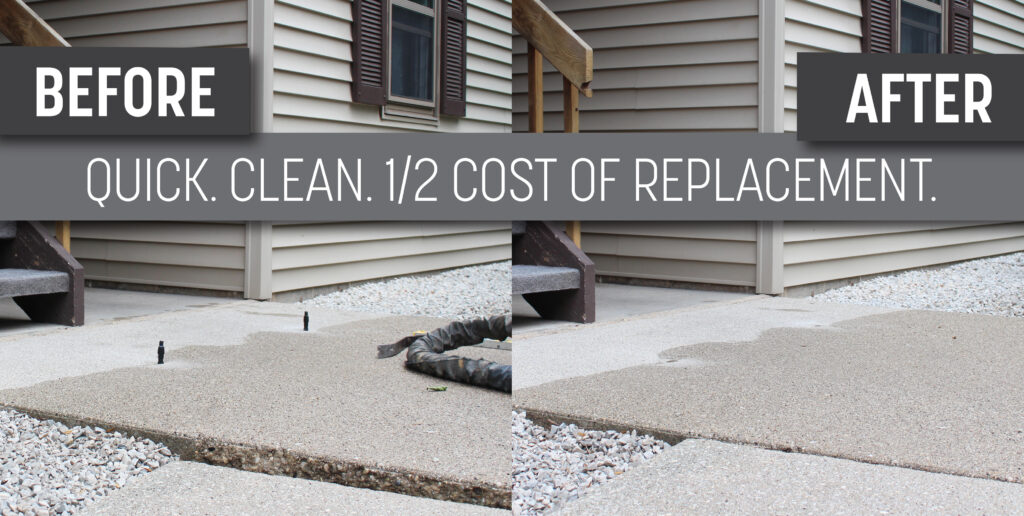
It Starts Underneath Your Concrete
When your home was built, the movement of soil around the building site results in poor compaction. Even when the replaced soil is compacted well, it’s never as stable as the original soil. Over time, this can cause voids to form and slabs to settle.
Another cause of soil failure is drought. During dry conditions or even just during periods of warm weather and low precipitation, the soil under your concrete will dry out and shrink, creating voids. The concrete above eventually cracks and sinks into these empty spaces; especially if any weight is placed on it.
When the rains return, the water has an even easier pathway under the slab due to cracks and crevices left over from the dry period. And this wet, soft soil is just too weak to support the concrete above it. In the worst case, the soil erodes and washes away completely, leaving behind large voids that cannot support the weight of the concrete above.